


Why Smart Founders Don’t Buy Digital Services à La Carte
There’s a version of outsourcing that sounds smart on paper. You hire a freelance graphic designer for your social posts, a separate copywriter for the captions, and maybe a virtual assistant to schedule and publish.
Each individual hire looks lean and affordable. And then three weeks in, you find yourself spending half your week coordinating between people who have never spoken to each other, chasing deliverables across three different tools, re-explaining your brand voice every month when someone new comes in, and realising that posts still aren’t going out on time.
The à la carte approach to digital marketing isn’t cheaper. It’s just cheaper-looking.
This post is about why the founders who have figured this out think differently about outsourcing, and what the alternative actually involves in practice.
The Hidden Cost That Doesn’t Show Up on Any Invoice
The appeal of piecing together a team of individual specialists is real because you feel you have control, you’re not locked in, and each line item looks manageable. A designer at $150 per month. A copywriter at $200. A VA for scheduling at $100. On a spreadsheet, that’s $450 and it sounds reasonable.
But what that spreadsheet doesn’t show is the coordination overhead sitting on top of it.
Picture this: you approve a new campaign concept for the month. You write a brief and send it to your designer. The designer produces the visuals. You forward those visuals to your copywriter. The copywriter writes captions but didn’t see the creative brief, so the tone is slightly off. You request changes. Two rounds later, the files are finally with your VA but it’s already the 10th of the month and the window for the campaign has narrowed. The posts go out late bunched together, and with no strategic spacing.
None of those people did anything wrong. But when strategy, design, copy, and scheduling live in separate people’s heads with no shared context, the founder becomes the connective tissue between all of them. And that’s expensive in the one currency founders can least afford to spend: time.
According to the Upwork Research Institute’s Q1 2026 Business Leader Landscape survey, SMBs engage freelancers primarily for speed and access to specialised skills. But the same research notes that coordination overhead is one of the most cited friction points that erodes the speed advantage entirely when not managed properly.
What “Full Service” Actually Means — And Why It’s Different
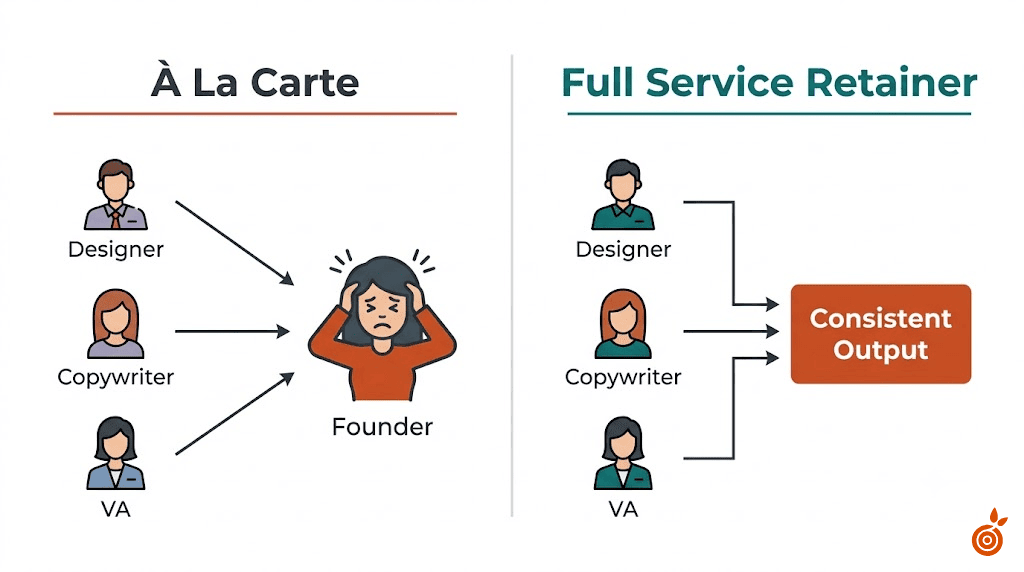
A retainer with a full-service agency isn’t just a bundle of services. It’s a transfer of coordination responsibility where the agency holds the brief; maintains the brand context; manages the internal workflow between strategy, design, copy, and scheduling; and delivers the finished output.
You don’t manage the people. You only review and approve outcomes.
This practical difference between à la carte and full service shows up in three specific ways:
Everything operates from the same brief. The strategist who defines the content pillars for the month is the same team informing the designer and the copywriter. There’s no telephone game between separately hired people. When your brand voice and visual identity are established in month one, they’re maintained in month six without you re-explaining them.
You approve the plan once, then execution begins. At OutSprout, the first step for every social media retainer client is a full monthly content calendar — every post, every platform, every date mapped out — shared as an editable document before any creative work starts. The client reviews it, makes changes directly in the document, and signs off. Only then does production begin: graphic design, caption writing, ad campaign setup. The client’s involvement after that point is intentionally minimal.
Consistency is structural, not dependent on individual freelancer availability. One of the most common failure modes of piecing together a freelance team is the disappearing act — a designer who’s great when available but has four other clients, and your work slips whenever things get busy on their end. With a retainer, you’re a recurring client with a committed delivery schedule, not a project competing for attention in someone’s queue.
A Real Example: What a Social Media Retainer Looks Like Month to Month
Clean Care — a Pakistani hygiene products brand selling disposable sufrah sheets, barber aprons, and multi-purpose aprons — came to OutSprout for full social media management. Their challenge was establishing a brand presence across multiple platforms from scratch, while running ad campaigns alongside organic content.
Here is exactly what OutSprout’s monthly retainer covers for them:
- Strategy layer: Content strategy, including monthly themes, content pillars, campaign planning, and platform-specific direction. This is developed first and forms the foundation everything else is built on.
- Production layer: Graphic design and visual creation for every post. Caption copywriting for all platforms. Ad campaign creation and management — creative assets, audience targeting, and setup.
- Delivery layer: Scheduling and publishing through an automated pipeline. Monthly performance reporting covering reach, engagement, and campaign results.
- The approval process: Before any design or writing begins, a full monthly calendar is built and shared with the client as an editable document. Clean Care reviews the entire month’s plan, makes any changes needed, and signs off. Then and only then does production start. This means the client has full strategic input upfront without being involved in the execution details throughout the month.
What’s not included: Ad spend (the budget paid directly to Meta or other platforms) is separate from the retainer. The retainer covers campaign creation and management; the media budget goes from the client directly to the platform. Community management (responding to comments, DMs, and messages) also falls outside this scope and is discussed separately when brands need it.
With such a defined scope, both sides know exactly what’s included before the first month begins.
The Comparison Founders Actually Need to Make
Most founders comparing their options think about the upfront cost. But the more important comparison is operational — what each model actually requires from you day to day.
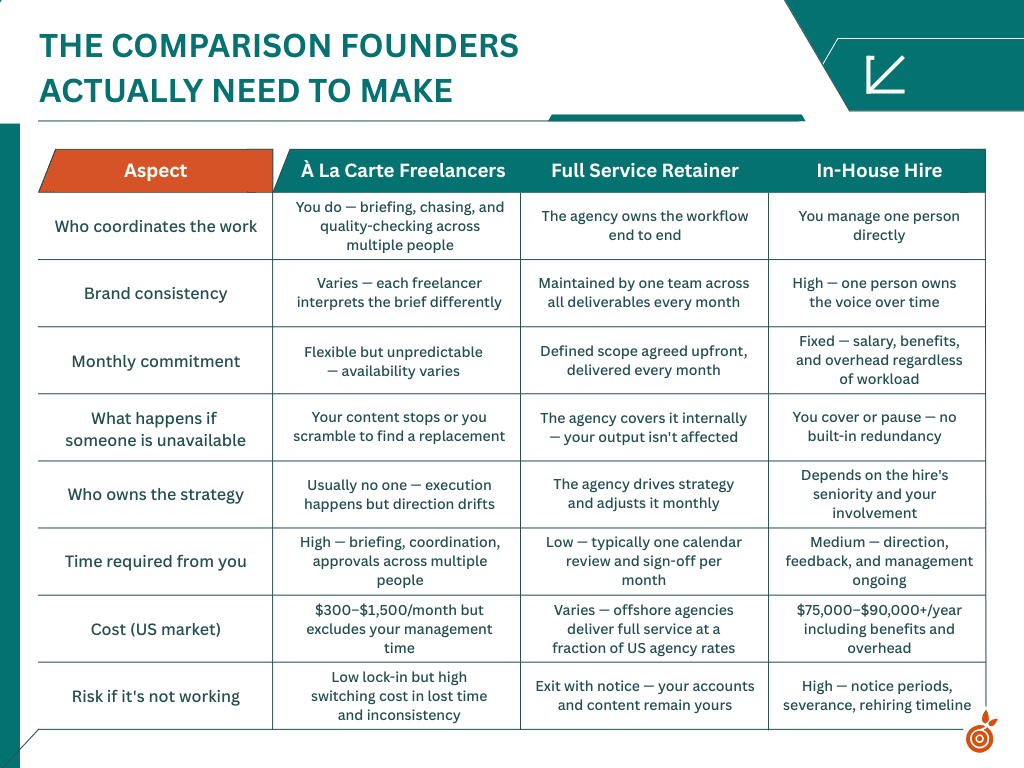
À la carte freelancers give you flexibility and lower individual rates. What you’re trading for that flexibility is your own time spent managing, briefing, coordinating, and quality-checking across multiple people. Industry benchmarks in 2026 put freelance social media management packages at $300–$1,500 per month, but that range almost never accounts for your time managing the relationship, onboarding replacements when someone leaves, or absorbing the inconsistency when your designer goes on holiday and your copywriter doesn’t know.
A full-service retainer moves coordination off your plate entirely. The agency owns the workflow, the brief, the timeline, and the output. You invest time in the strategy review and calendar approval upfront — typically a couple of hours per month — and receive a complete, consistent, executed presence in return. According to industry pricing benchmarks for 2026, US-based social media agencies typically start at $2,000–$4,000 per month for standard packages. Quality offshore agencies with the same full-service capability operate at a meaningful fraction of that.
An in-house hire gives you the most control and the deepest brand alignment over time, but at a cost that’s difficult to justify at early or growth stages. According to the US Bureau of Labor Statistics’ May 2024 Occupational Employment and Wage Statistics, the median annual wage for social media and digital communications roles sits above $60,000. Add benefits, software subscriptions, and management overhead, and the true cost of a full-time social media manager runs $75,000–$90,000+ annually — before they produce a single post.
When à La Carte Hiring Is the Right Answer
This isn’t to say that retainers are always better. They’re not right for every stage or every need.
Piecing together individual freelancers makes sense when:
- You have a one-time project with a clear, bounded scope — a brand identity, a single campaign, a specific landing page
- You’re at very early stage with genuinely inconsistent output needs
- You have strong in-house marketing capacity and need specialist overflow for a specific skill gap
A full-service retainer makes sense when:
- You need consistent output month after month across social media, content, or web
- You’re spending more time managing digital freelancers than running your business
- Your online presence is technically active but inconsistent because no single person owns the full picture
- You want an agency that manages the strategy, not just executes tasks you hand them
The founders who get the most value from a retainer come in with a clear brand direction and the discipline to review and approve rather than micromanage execution. The ones who struggle with it want the benefits of full delegation without fully letting go of the day-to-day decisions. That tension is worth examining honestly before choosing either model.
Frequently Asked Questions
What’s the difference between a project and a retainer? A project is a one-time engagement — a website build, a brand identity, a campaign. A retainer is an ongoing relationship where a defined scope of work is delivered every month: social media management, content creation, web maintenance, blog creation. Projects end; retainers compound as the agency builds deeper context about your brand and audience over time.
How do I know a retainer is worth it before I see results? Most digital channels — social media, content, SEO — take 60 to 90 days to show meaningful movement. Evaluate a retainer against agreed KPIs set at the start: reach, engagement growth, lead volume. Month-on-month movement against those metrics tells you whether the investment is working, not week-one numbers.
Does the agency own my accounts and content? No. Your platforms, ad accounts, content, and data remain yours throughout. The agency manages them on your behalf. If the relationship ends, you retain full access to everything built during the engagement. Any agency worth working with confirms this in writing before the first month begins.
What exactly is ad spend, and why is it separate from the retainer? Ad spend is the budget paid directly to advertising platforms — Meta, Google, TikTok — to distribute your content to paid audiences. It’s separate because it goes from your account directly to the platform, not to the agency. The retainer covers building and managing the campaigns; the ad budget is what you choose to invest in paid reach. A transparent agency reports on both clearly and keeps them completely separate.
How much involvement do I need once the retainer starts? At OutSprout, the main touchpoint is the monthly calendar review — typically one to two hours at the start of each month. After sign-off, the team handles production, scheduling, and publishing. You check in periodically, or on the monthly performance report and flag anything you want adjusted going into the next month.
Stop Doing Everything Yourself.
The à la carte approach feels like control. In practice, for most founders, it becomes another management job on top of the business they’re trying to run. The posts don’t go out consistently. The brand voice drifts. The brief gets lost between the designer and the copywriter. And the founder absorbs all of it because there’s no one else holding the thread.
A retainer hands that thread to someone else — with a defined scope, a structured approval process, and a team that builds context about your brand month after month. The output gets better over time, not in spite of outsourcing, but because of it.
OutSprout works with international founders and small business owners who want a consistent, professionally managed digital presence without the overhead of building and managing a team themselves. If you’d like to understand what a retainer would look like for your specific business, book a free discovery call with us.