

How to Hire an Offshore Web Design Agency
You’ve found an agency that looks promising. The portfolio is strong. The pricing is a fraction of what agencies in your country quoted. The founder seems sharp on the discovery call.
And then you pause.
What if they go quiet after the deposit? What if the final site looks nothing like the proposal? What if “we’ll handle revisions” means one round and then a change order for everything after that?
These aren’t irrational fears. They’re the product of real experiences — founders who wired money to agencies only to receive mediocre templates dressed up as custom work, or who spent three months chasing responses across time zones while their launch date kept moving. The offshore web design horror story is common enough that it’s become a reason many founders don’t even consider going that route.
And that’s a shame, because when offshore works — and it works often — the result is indistinguishable from what a premium local agency would deliver, at a fraction of the cost.
Why Offshore Web Design Has Become the Default for Smart Founders
The case for going offshore isn’t just about saving money anymore. According to Deloitte’s 2024 Global Outsourcing Survey, cost reduction has fallen dramatically as the primary reason businesses outsource — from 70% of executives citing it as their main driver in 2020 to just 34% today. What replaced it? Growing access to skilled talent and better service quality than what founders could get locally, at a price point that made sense.
The savings, however, are still significant. Web design and development rates at US and UK agencies typically start at $100 per hour and climb well above $150 for senior talent. Quality offshore agencies operate at a fraction of that. And for a small business owner building a brand from scratch, that’s more than just a minor discount.
According to Clutch’s 2025 State of Small Business Websites report, 45% of small businesses already outsource their website to a web design agency, and those who choose professional agencies over freelancers give a consistent reason: agencies bring structure, process, and accountability that individual freelancers typically can’t match.
What Actually Goes Wrong — And Why
Before getting into what good looks like, it’s worth being specific about how offshore engagements fail.
But rather than just offshore-specific problems, these are actually project management problems that become harder to resolve when you’re operating across time zones without the option of walking into someone’s office.
Here’s what each failure mode looks like in practice:
Scope creep: You brief the agency on a five-page website. Two weeks in, they tell you the e-commerce functionality you mentioned in passing isn’t included in the quote. Neither is the contact form. Neither, apparently, is mobile optimisation. Each addition comes with a new invoice. The project that looked affordable at the start has doubled in cost by the time you launch — if you launch.
Poor communication: You send a detailed brief on Monday. By Thursday, nothing. You follow up. They reply Friday afternoon with a question that was answered on page two of the brief. That loop — send, wait, follow up, get a partial response, clarify, wait again — plays out across every stage of the project. A four-week timeline becomes ten, and you stop trusting their estimates entirely.
Unrealistic timelines: The agency promises delivery in three weeks because that’s what you said you needed to hear. But they knew on day one it wasn’t realistic. Mid-project, they go quiet. When they resurface, there’s a new estimate and an explanation involving team availability. And the site you needed for your product launch is still unfinished the week before the event.
However, recognising these patterns before they start is entirely possible because they always have early warning signals.
6 Red Flags That Reveal an Agency Before You’ve Spent a Penny
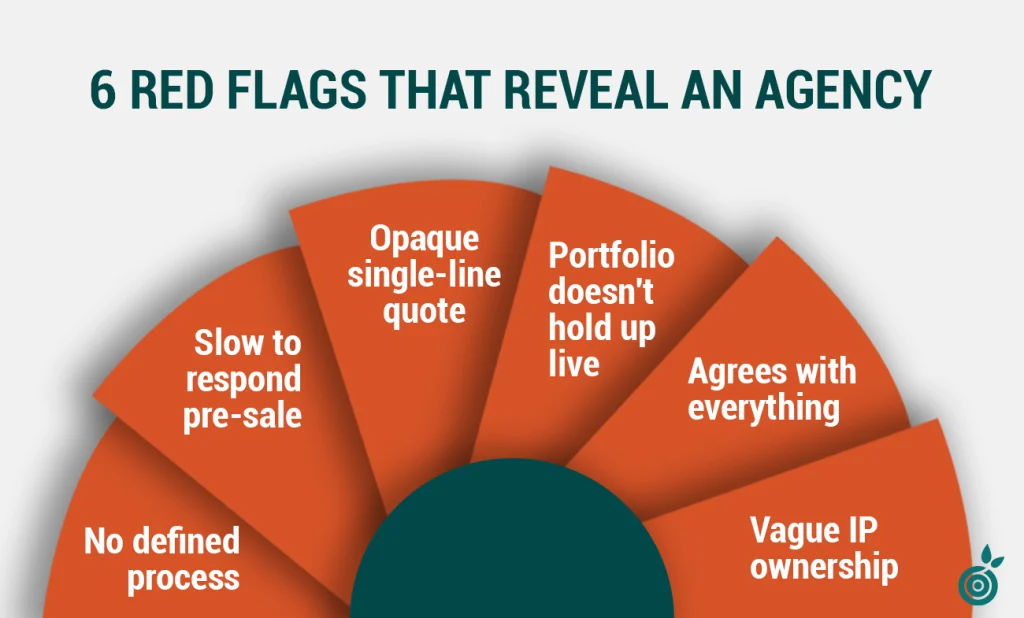
1. They can’t describe their process in concrete steps
Ask any agency you’re considering: “Walk me through exactly what happens from the day I sign to the day the site goes live.” A professional agency answers this with specificity: discovery session, brand questionnaire, wireframes, design concepts, revision rounds, development build, testing, handover. Each stage has a name, an owner, and a deliverable.
An agency that responds with “we’ll collaborate closely with you throughout” or “every project is different so we figure it out as we go” is telling you something important: there is no process. And without a process, there’s no accountability when things slip.
2. Their response time during the sales process is already slow
This is the single most reliable predictor of how communication will feel six weeks into the project, when you’re deep in revisions and waiting for answers that affect your launch timeline.
If they take two days to reply to your first inquiry, or if they show up to a discovery call unprepared, that’s not a one-off — that’s the standard. An agency that’s genuinely excited to work with you and runs a professional operation treats the sales process with the same care as the project itself.
3. The quote is a single number with no breakdown
A quote that says “$2,500 — website design and development” tells you nothing useful and protects you against nothing. A professional quote breaks down every component: discovery and strategy; design (how many pages, how many concepts, how many revision rounds); development; testing; and any third-party costs like themes, plugins, business tools, or hosting setup.
When a quote is opaque, expect change orders to come through. The scope is deliberately vague so the agency can recover margin later. The financially safe move here is to treat any single-line quote as a red flag and ask for itemisation before signing anything.
4. Their portfolio doesn’t hold up when you actually visit the sites
Screenshots lie. A site can look stunning in a static image and be a disaster in practice. Slow to load, broken on mobile, confusing to navigate, or with a checkout flow that loses customers at every step.
When you review an agency’s portfolio, visit every site listed. Load it on your phone. Click through the navigation. Try to complete the core action the site is built for: buying a product, making a booking, filling a form. This is where you’ll see the actual quality of their work, not the curated version.
5. They agree with everything you say
This one might surprise you, but it’s a genuine warning sign. A confident, experienced agency pushes back. They’ll tell you your timeline is unrealistic, that a certain design direction won’t convert, that the feature you want will add three weeks to the build.
That friction is what professionalism sounds like.
An agency that says yes to everything in the sales process — your timeline, your budget, your feature list, your aesthetic preferences — without question is either inexperienced or building a case for “scope changes” after the deposit is paid. Healthy disagreement early on is a sign of ownership whereas silence is often a warning.
6. The contract is vague about who owns the site when you’re done
Some agency contracts state that intellectual property remains with the agency until the final invoice is paid in full. That sounds reasonable until a payment dispute means the agency can withhold access to your live site. You can’t update it, move it, or hand it to another developer until the matter is resolved — on their terms.
More concerning are contracts that never transfer ownership at all, granting only a licence to use the work. This means you can’t take your site to another developer without starting from scratch.
Before signing, confirm in writing that full intellectual property transfers to you upon final payment, that you’ll receive all source files and login credentials at handover, and that no ongoing licence fees apply to use the work they’ve built for you.
What It Actually Looks Like When an Offshore Agency Gets It Right
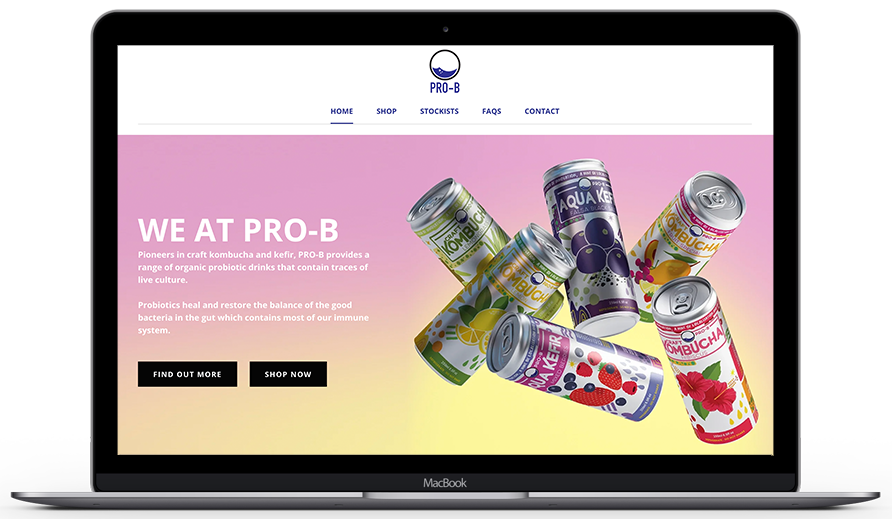
When PRO-B, Pakistan’s first craft kombucha and kefir brand, needed a website, the brief was genuinely complex. The brand was introducing a product category most of their target market had never heard of. The site needed to educate first-time visitors about what kombucha and kefir actually are, convert the skeptical into buyers, and do all of that while feeling premium, approachable, and unmistakably craft.
OutSprout built the complete Shopify experience from scratch: a bright and bold premium visual identity. Dedicated pages for each of PRO-B’s three drink lines — kombucha, aqua kefir, and milk kefir — each with educational content written to move a curious visitor toward a purchase.
PRO-B’s founder described the process: “No matter how small the change or how random my feedback was, he handled everything quickly and with a really positive attitude. There was never a point where I felt ignored, delayed, or misunderstood — which is rare when working on creative projects where details matter this much.”
He wasn’t comparing OutSprout to other offshore agencies. He was comparing the experience to creative projects in general, and noting that this level of communication and responsiveness was the exception, not the rule.
The site is live at healthyguts.co and still maintained by OutSprout today.
Before You Sign Anything: A Practical Vetting Checklist
Run every agency you’re seriously considering through this before committing:
On their work:
- Have you visited the live versions of their portfolio sites on mobile, not just screenshots?
- Did the sites load in under three seconds?
- Could you complete the core action (buy, book, enquire) without confusion?
- Can they describe a specific past project in detail — the brief, the challenge, the solution?
On their process:
- Can they name every stage of their project workflow and the deliverable at each stage?
- Do they use a project management tool (Notion, Asana, Airtable) where you’ll have visibility throughout?
- How do they handle revision requests, and is there a defined process and a limit?
- Who is your named point of contact throughout the project?
On their communication:
- Did they respond to your initial inquiry within 24 hours?
- Were they prepared and specific on the discovery call?
- Did they ask questions that showed they’d read your brief?
On their contract:
- Is the quote broken down by deliverable, not a single lump sum?
- Does the contract confirm full IP transfer to you on final payment?
- Are revision rounds, timelines, and milestones in writing?
- Is there a clause covering what happens if deadlines are missed?
Download this checklist and save it for future use.
How to Structure the Engagement to Protect Yourself
Even with the right agency, the relationship benefits from structure on your side too. The founders and business owners who get the best results from offshore partnerships come in with clarity about what they need and when.
Start with a paid discovery phase. Before the full build begins, commission a discovery document — a written brief, a set of wireframes, or a strategy session with notes. This serves two purposes. First, it tests the agency’s thinking before you’ve committed to a large build. Second, it forces the scope into writing before any design or development work starts, which is the most reliable way to prevent scope creep.
Pay in milestones, not large upfront sums. A standard professional structure looks like this: 30–40% deposit to begin, a second payment on design approval, a third on development completion, and a final payment on launch. Each milestone is tied to a specific deliverable. If a milestone isn’t met to standard, the next payment isn’t triggered. This keeps both sides accountable throughout.
Define “done” before work starts. The most common source of end-of-project tension is that the client and agency had different mental images of the finished product. A scope document that names every page, every feature, every integration, and every deliverable is the thing that prevents that tension. It only takes about an hour to create but can save weeks of disputes.
Frequently Asked Questions
How do I verify an offshore agency’s portfolio is genuinely their work? Visit every live site listed. Ask the agency to walk you through a specific project on a call: what the brief was, what decisions they made and why, what challenges came up. An agency that did the work can answer these questions fluently but one that didn’t will speak in generalities.
Is it safe to pay a deposit to an offshore agency? A deposit of 30-40% is standard. Anything above 50% upfront is unusual but could be reasonable depending on the scope of work involved such as third-party costs. Milestone-based payment structures protect both parties — the agency has financial certainty at each stage, and you retain leverage until the work is delivered.
What should I do if the agency goes quiet mid-project? Escalate in writing immediately and set a clear deadline for response. If they remain unresponsive beyond that, send a formal written notice referencing the contract terms and timeline commitments. This is why milestone-based payment structures matter: you should never be in a position where you’ve paid the majority of the fee before the majority of the work is delivered.
How do time zone differences affect the project? Less than most founders expect, when managed well. Agreeing upfront on a weekly check-in call, a shared project management workspace, and a 24-hour response time for async messages handles the vast majority of coordination. The agencies that struggle with time zones are the ones with no established communication rhythm. The problem is not the time zone itself.
Premium Work Without the Premium Price Tag
The offshore web design horror story exists because some founders skip the steps that would have caught the problem before the deposit was paid. The portfolio visit that would have revealed slow, broken sites. The discovery call question that would have exposed the absence of a process. The contract review that would have flagged the IP clause.
None of these steps are complicated. They just require treating an offshore agency with the same professional diligence you’d bring to any significant business decision.
Do that, and geography stops being a risk factor. It becomes the reason you got a site that rivals anything a premium local agency would have built — while keeping the rest of your budget for the business that site is meant to grow.
OutSprout works with international founders and small business owners who want premium digital work without the premium price tag. If you want to understand exactly how we work — our process, our timelines, and what to expect — book a free, zero-commitment discovery call with us.